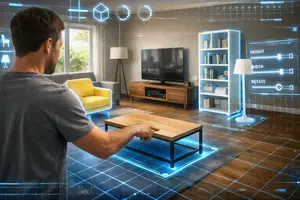
From immersive hotel tours to virtual design showrooms and collaborative workspaces, AR and VR are reshaping how we design spaces, sell experiences, and work together.
Imagine approving a hotel lobby design while standing inside it — months before construction even begins.
Or walking through your future home, testing different fabrics, lighting, and furniture layouts before a single wall is built.
Now imagine meeting with your colleagues in a shared virtual workspace that feels more natural than a video call ever could.
This isn’t science fiction anymore.
Virtual Reality (VR) and Augmented Reality (AR) have officially moved beyond gaming. As the global AR/VR market accelerates toward an estimated $165 billion by 2030, immersive technology is rapidly becoming a practical tool for industries that rely on visualization, collaboration, and customer experience.
Design, hospitality, and remote work are among the sectors experiencing the biggest transformation.
The screen that once separated us is evolving into something far more powerful: a portal.
1. The End of the Physical Prototype
For decades, designers and architects have struggled with a common challenge: helping clients visualize what doesn’t yet exist.
A tiny fabric swatch. A rendering on a laptop screen. A scaled model on a table.
For many clients, these tools require imagination that not everyone possesses.
Virtual Reality eliminates that gap.
Instead of interpreting blueprints, clients can step directly into a fully immersive three-dimensional environment. They can walk through a hotel lobby, stand inside a future living room, or explore the layout of a restaurant before construction even begins.
For hospitality and residential design firms alike, this shift is significant.
VR allows designers and clients to:
- Experience the scale and lighting of a space
- Experiment with materials and finishes in real time
- Test furniture layouts instantly
- Identify potential design challenges before construction begins
This dramatically reduces costly revisions and miscommunications.
Furniture vendors and manufacturers are also embracing immersive environments to transform their sales process.
Instead of relying on limited trade show booths or static catalogs, companies are building 24/7 virtual showrooms where designers can explore entire product lines, swap fabrics and finishes instantly, and test layouts inside digital spaces.
For residential designers, this means homeowners can explore design options with confidence. For hospitality groups managing large-scale developments, it means teams can align quickly around a shared vision.
Some immersive platforms even include “Empathy Mode,” allowing designers to view spaces through different lenses — such as mobility limitations or sensory sensitivities — helping teams identify accessibility challenges before a space is ever built.
2. Hospitality Enters the “Try Before You Book” Era
The hospitality industry has always relied on visuals to sell an experience.
But traditional photos and videos can only go so far.
Today, hotels and travel brands are experimenting with immersive previews that allow guests to explore a property before they book.
Through virtual hotel tours, potential guests can:
- Walk through their future room
- Explore the pool, spa, and restaurants
- Experience the overall layout of a resort
Instead of imagining the stay, they experience it.
This approach has powerful implications for booking behavior. Studies have shown that immersive previews can significantly increase customer confidence and conversion rates because guests feel they understand the experience before committing.
The booking process itself is also evolving.
Developers are experimenting with VR-based travel planning, where users can browse destinations, compare hotels, and even complete reservations entirely within a virtual environment.
For hospitality brands competing in a crowded market, immersive previews offer something traditional marketing cannot: certainty.
Guests don’t just see the experience — they step into it.
3. The VR Office: A Cure for Remote Work Fatigue
While immersive design tools are transforming architecture and hospitality, VR may have an equally profound impact on how we work.
Remote work unlocked flexibility for millions of professionals, but it also introduced new challenges. Video conferencing often feels awkward and exhausting. Conversations overlap. Body language disappears. Creativity can suffer.
Researchers have even coined the term “Zoom fatigue.”
Virtual workspaces aim to solve this by restoring a sense of presence.
Inside a VR meeting environment, participants appear as avatars within a shared space. Instead of staring at a grid of faces, coworkers gather around a table, stand at whiteboards, or walk together through digital environments.
Spatial audio makes the experience feel natural — voices become louder as someone moves closer and quieter as they move away.
This allows for something video calls struggle to replicate: organic conversation.
Colleagues can have quick side discussions, break into small brainstorming groups, or collaborate visually in ways that feel far more like an in-person meeting.
Perhaps most importantly, immersive workspaces help eliminate proximity bias, a common issue in hybrid workplaces where in-office employees receive more visibility than remote colleagues.
When everyone joins the same virtual environment, the playing field becomes level.
And when it’s time to focus?
Workers can transport themselves to distraction-free environments — a quiet digital library, a peaceful mountaintop workspace, or a private creative studio.
Where Hospitality and Home Design Meet
One of the most exciting aspects of immersive technology is how it blurs traditional boundaries between industries.
The same tools used to design hotel lobbies can help homeowners visualize a kitchen renovation.
A hospitality furniture vendor can showcase collections to global design firms while also helping residential designers present options to private clients.
Immersive platforms allow designers, vendors, developers, and homeowners to interact inside shared spaces that support both large-scale commercial projects and individual residential design.
In other words, the technology is flexible enough to support both worlds — hospitality and home — while still allowing each to operate independently.
That balance is where the real opportunity lies.
The Takeaway
The screen that once separated us is transforming into something much more powerful.
A portal.
Immersive technology is redefining how we design spaces, market experiences, and collaborate across distances. From hotel developers and furniture vendors to residential designers and homeowners, the ability to step inside an idea before it becomes reality is changing expectations across the entire built environment.
The companies that embrace immersive collaboration today will shape how the world designs, travels, and works tomorrow.
And increasingly, that future is not just digital.
It’s immersive